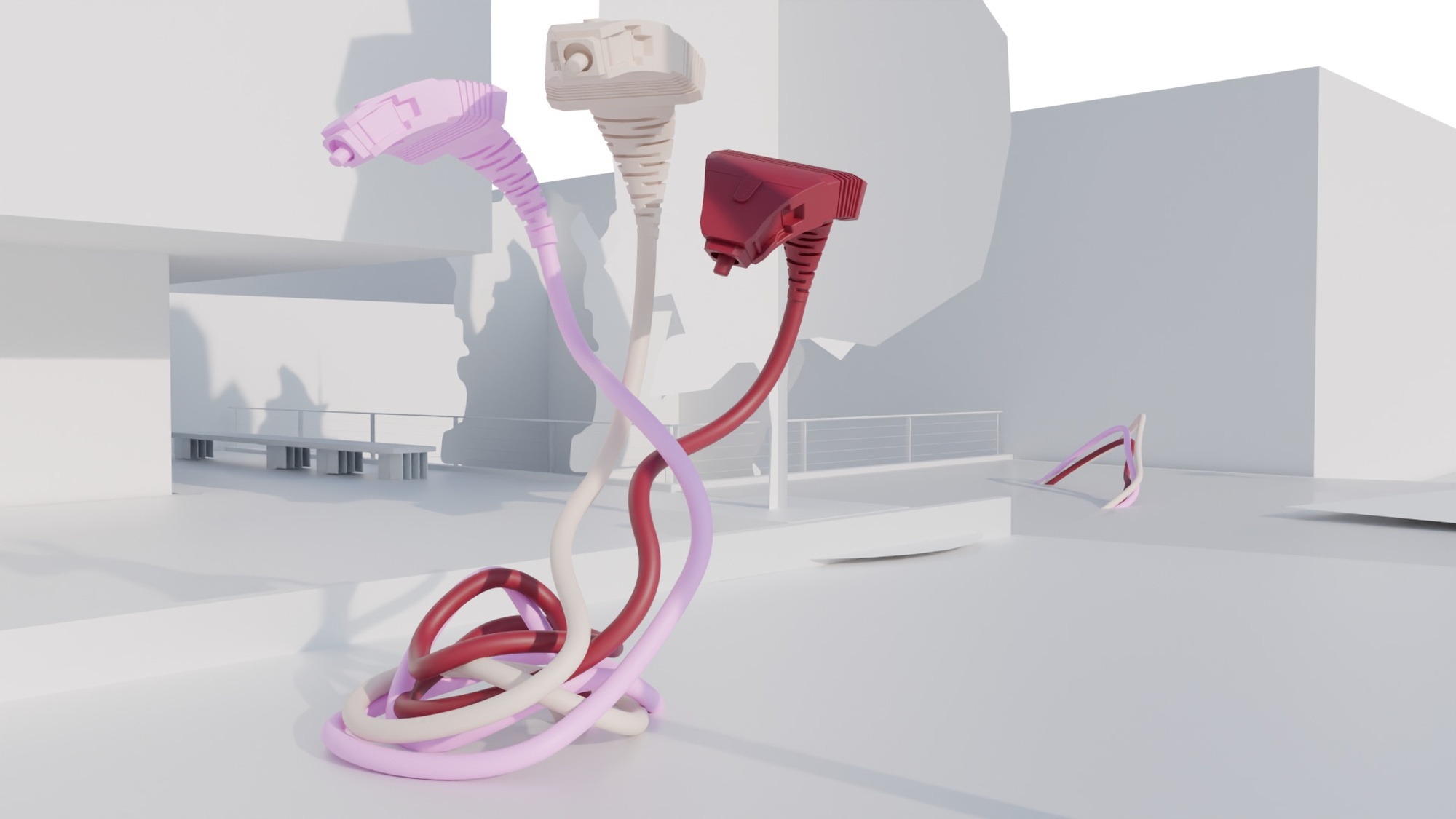
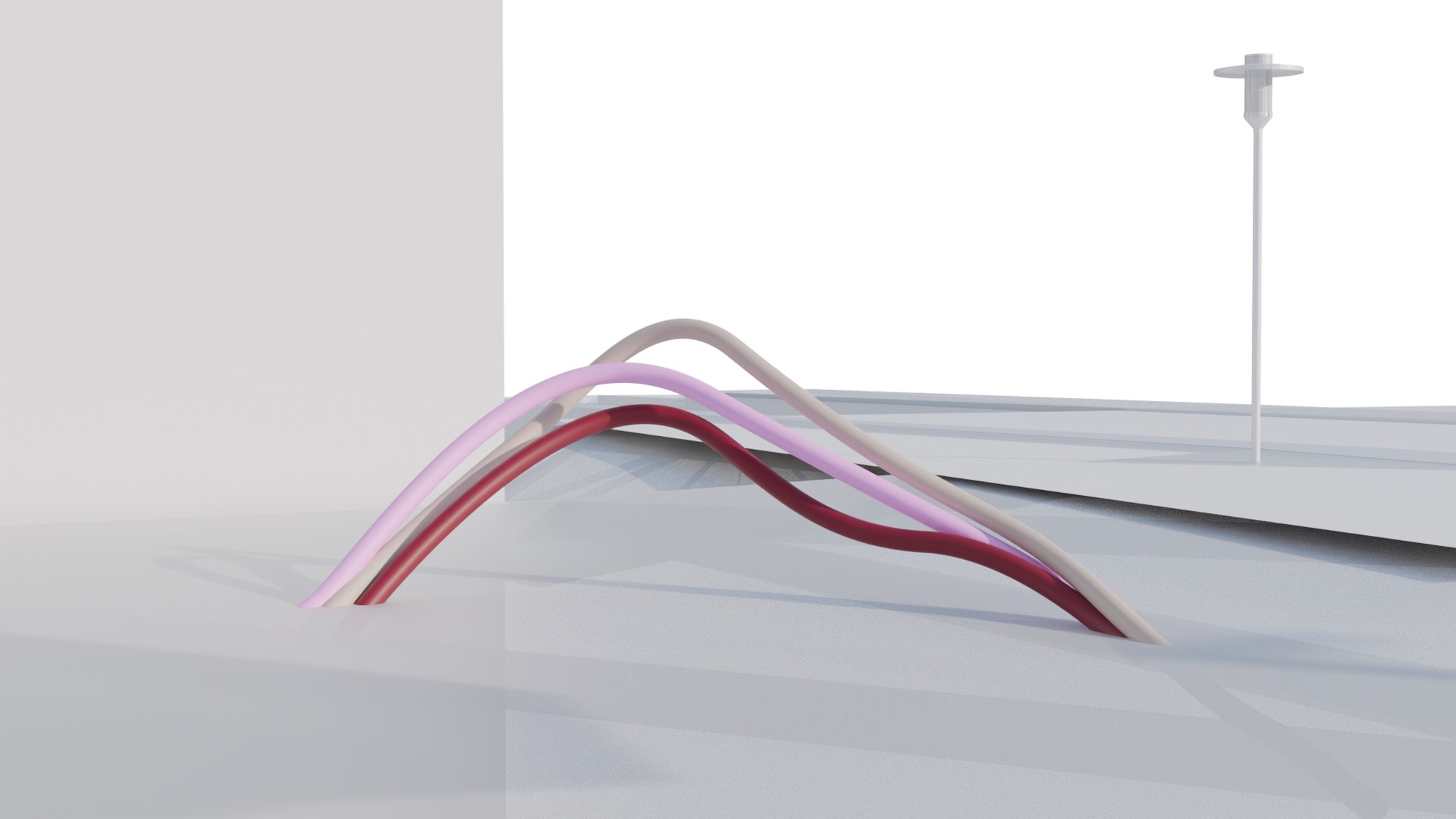
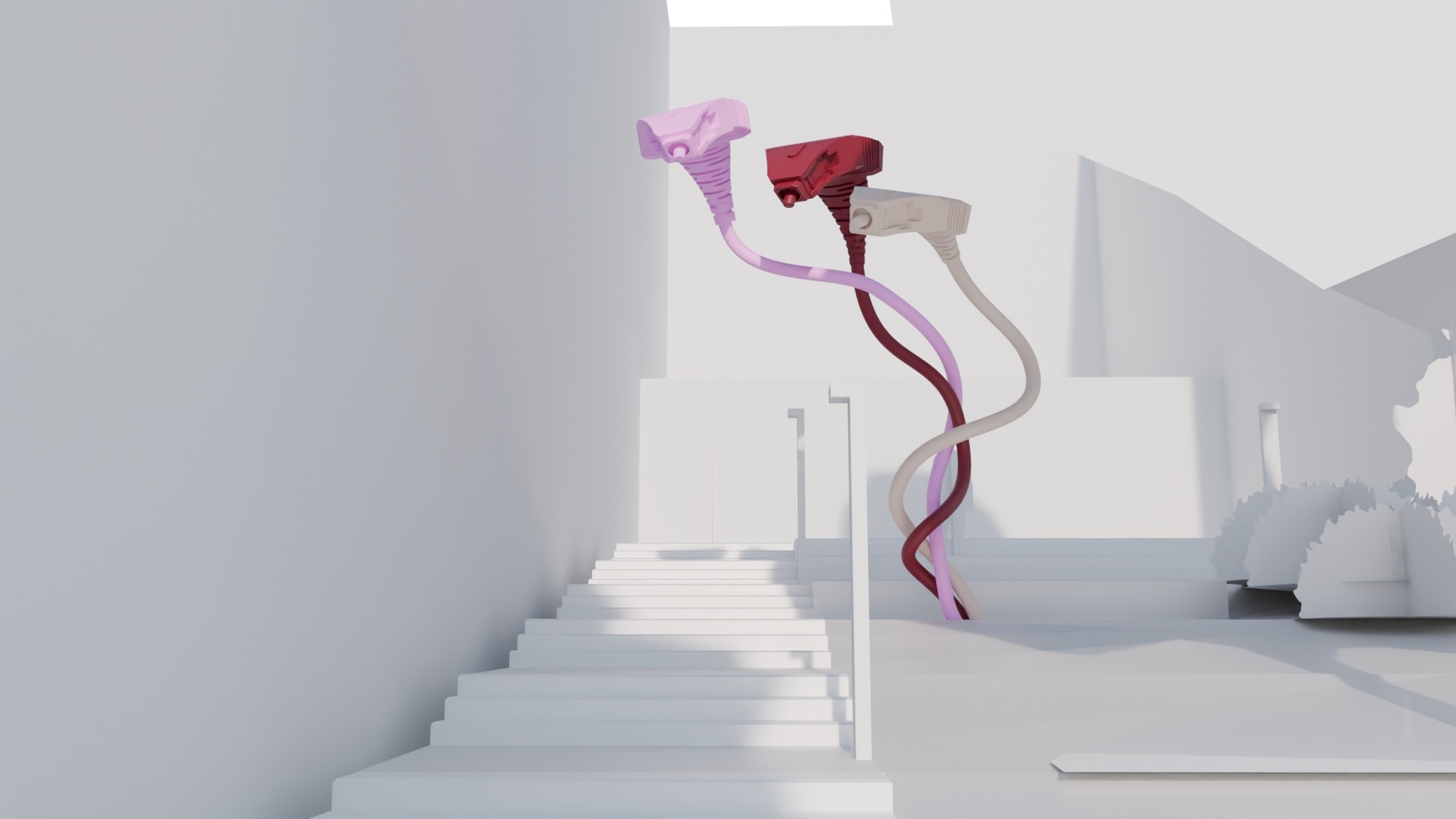
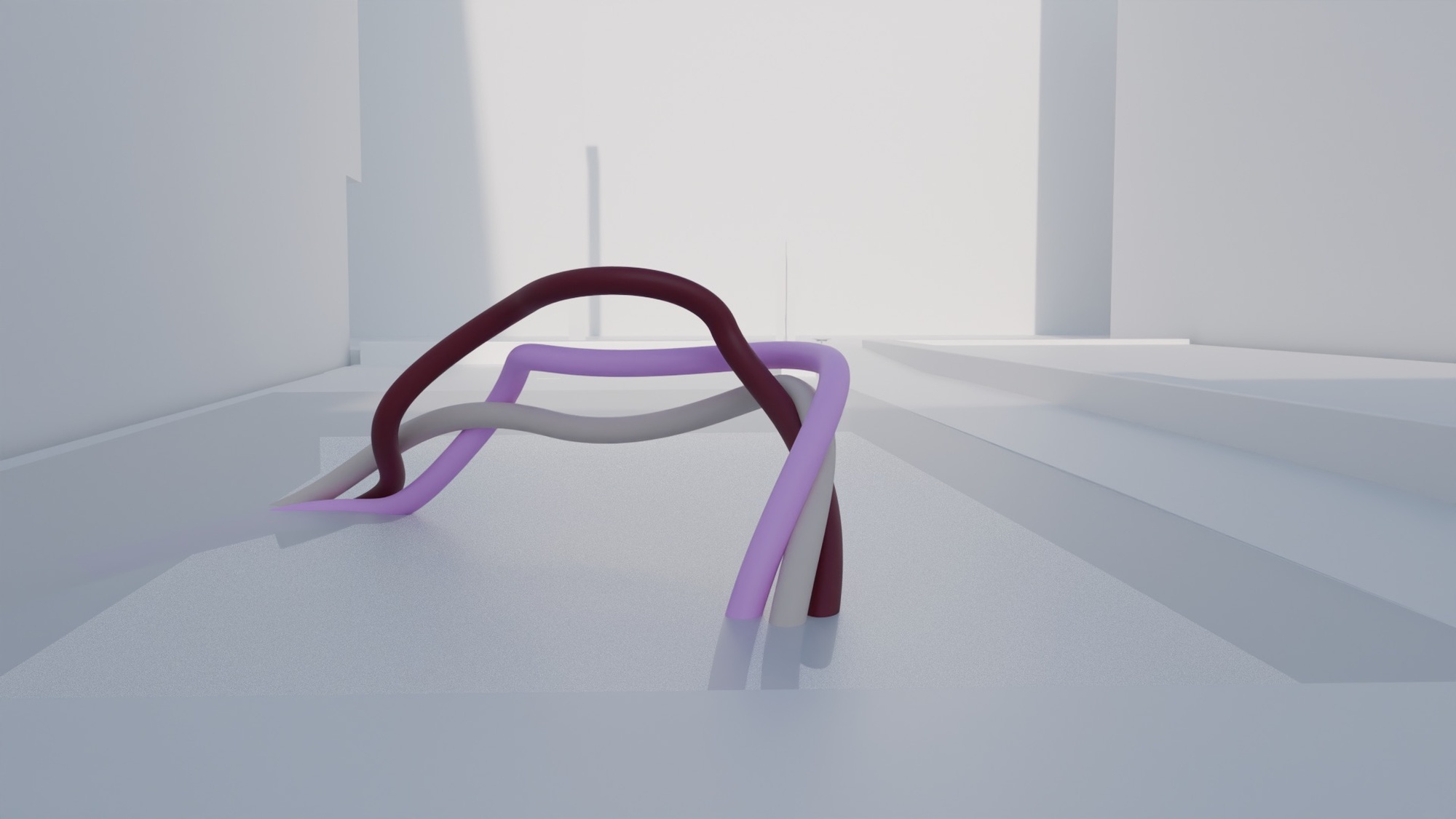
The Networkers, 2026
Rendering for Fraunhofer Institute, St. Augustin, Germany
The Networkers, 2026
Rendering for Fraunhofer Institute, St. Augustin, Germany
The Networkers, 2026
Rendering for Fraunhofer Institute, St. Augustin, Germany
The Networkers, 2026
Rendering for Fraunhofer Institute, St. Augustin, Germany
The Networkers, 2026
Rendering for Fraunhofer Institute, St. Augustin, Germany
The Networkers, Fraunhofer Institute (Winner - Inauguration 2026)
Scroll Down for German
As part of the expansion and redevelopment of the Fraunhofer Institute Center Schloss Birlinghoven into a Center for Intelligent Computing in Sankt Augustin, and in response to the Art-in-Architecture competition announced for this project, I propose the sculptural ensemble The Networkers.
Following a linear movement, a four-part steel and bronze sculpture reminiscent of a bundle of cables winds across the grounds of the new Center for Intelligent Computing building at the Fraunhofer Institute Center Schloss Birlinghoven. Like the nerve pathways of a neural network, the metal elements—painted in wine red, pink, and white—emerge from the ground at four locations, appearing to wind around the building structure, to playfully surround it, and to penetrate it.
The work is based on standard OM4 multimode fiber optic cables, as used in the Fraunhofer Institute’s data center for high-speed transmission. Their function as light conductors is here sculpturally amplified: the medium of connection itself becomes the motif. The work examines one of the most powerful and yet rarely reflected elements of the site, as well as of our everyday lives: the cable. As a conduit for information, energy, and speed, it stands for progress, control, and the invisible network that connects everything. In their curved forms, the sculptures recall anthropomorphic shapes—beings that twist, evade, and slip away. They are symbols of a structure of our present that appears monumental yet diffuse and omnipresent: fluid, intelligent, and adaptive.
On the one hand, the design refers to the function of the site—which has been repeatedly expanded over the past decades—as a research facility; on the other hand, it addresses the significance of the curved line in art and science. Here, it is understood as a mediator between nature, culture, science, and contemporary technologies, and as a vehicle of interdisciplinary research.
The project envisions a matte-painted metal ensemble that winds through four locations within the center, linking these places together. The colors of the sculptures stand out from the dark metallic and glass façades of the new building. The dynamic movement connects the plaza at the entrance with the garden and exit area at the rear, while the two elements in between mediate between above- and underground spaces, between visible and hidden realms.
Within the context of my artistic practice, the sculptural ensemble raises questions about cultural, technological, and therefore political hegemony: How does power manifest itself in form, material, and space? Where does progress shift into dominance, visibility into surveillance? Where are the vulnerable points of critical infrastructure?
The work touches upon questions of responsibility in research and in art—two fields that equally produce meaning and shape systems. Both project visions of the future and open up new spaces of knowledge and perception. With the ability to shape comes the power to define realities. Science and culture are expressions of social freedom and material security, yet at the same time reflections of the forces that can threaten both. They open up spaces of possibility and invite us to continually question our own actions within these structures.
The sculptural ensemble The Networkers understands the cable as a contemporary allegory: as a carrier of knowledge, but also as a symbol of global power structures formed by invisible relationships. In its quiet yet animated—and animating—presence, it is both a warning and a fascination, suspended between transparency and entanglement, between human invention and its unpredictable unfolding.
Im Rahmen der Erweiterung und des Umbaus des Fraunhofer-Institutszentrums Schloss Birlinghoven in ein Zentrum für Intelligent Computing in Sankt Augustin, und dem dafür ausgelobten Kunst-am-Bau-Wettbewerbs schlage ich die Skulpturengruppe The Networkers vor.
Einer linearen Bewegung folgend schlängelt sich eine vierteilige, an ein Kabelbündel erinnernde Stahl- und Bronzeplastik über das Gelände des Neubaus des Zentrums für Intelligent Computing am Fraunhofer-Institutszentrum Schloss Birlinghoven. Wie Nervenbahnen eines neuronalen Netzes treten die in Weinrot, Rosa und Weiß lackierten Metallelemente an vier Standorten aus dem Boden hervor, scheinen sich um den Baukörper zu winden, ihn zu umspielen und zu durchdringen.
Grundlage der Arbeit bilden handelsübliche OM4-Multimode-Glasfaserkabel, wie sie im Rechenzentrum des Fraunhofer-Instituts zur Hochgeschwindigkeitsübertragung eingesetzt werden. Ihre Funktion als Lichtleiter wird hier skulptural überhöht: das Medium der Verbindung selbst wird zum Motiv. Die Arbeit untersucht eines der machtvollsten und zugleich selten reflektierten Elemente des Standorts sowie unseres Alltags: das Kabel, Leiter von Information, Energie und Geschwindigkeit, steht für Fortschritt, Kontrolle und das unsichtbare Netz, das alles verbindet. In ihren geschwungenen Formen erinnern die Skulpturen an anthropomorphe Gebilde, Wesen, die sich winden, ausweichen, entgleiten. Sie sind Sinnbilder einer Struktur unserer Gegenwart, die monumental, gleichzeitig diffus und omnipräsent wirkt: fließend, intelligent und adaptiv.
Der Entwurf bezieht sich einerseits auf die Funktion des in den letzten Jahrzehnten immer wieder erweiterten Geländes als Forschungseinrichtung, andererseits auf die Bedeutung, die der geschwungenen Linie in Kunst und Wissenschaft zukommt. Sie gilt hier als Vermittlerin zwischen Natur, Kultur, Wissenschaft und aktuellen Technologien, und als Vehikel interdisziplinären Forschens.
Vorgesehen ist ein matt lackiertes Metall-Ensemble, das sich an vier Standorten innerhalb des Zentrums schlängelt und diese Orte miteinander verbindet. Die Farben der Skulpturen heben sich von den dunkel-metallischen und gläsernen Fassaden des Neubaus ab. Die schwungvolle Bewegung verbindet den Platz auf der Eingangsseite und den rückseitigen Garten-und Ausfahrtbereich, die beiden dazwischenliegenden Elemente vermitteln zwischen ober- und unterirdischen, sichtbaren und verborgenen Bereichen.
Im Kontext meiner künstlerischen Arbeit greift die Skulpturengruppe Fragen nach kultureller, technologischer und somit politischer Hegemonie auf: Wie manifestiert sich Macht in Form, Material und Raum? Wo kippt Fortschritt in Dominanz, Sichtbarkeit in Überwachung? Wo sind die vulnerablen Stellen einer kritischen Infrastruktur?
Die Arbeit berührt Fragen nach Verantwortung in Forschung und Kunst, zwei Feldern, die gleichermaßen Sinn erzeugen und Systeme formen. Beide entwerfen Zukunftsbilder, erschließen neue Räume des Wissens und der Wahrnehmung. Mit der Fähigkeit zu gestalten wächst auch die Macht, Realitäten zu bestimmen. Wissenschaft und Kultur sind Ausdruck gesellschaftlicher Freiheit und materieller Sicherheit, zugleich aber Spiegel jener Kräfte, die beides bedrohen können. Sie eröffnen Möglichkeitsräume und fordern dazu auf, das eigene Handeln innerhalb dieser Strukturen stets neu zu befragen.
Das skulpturale Ensemble The Networkers begreift das Kabel als zeitgenössische Allegorie: als Träger von Wissen, aber auch als Symbol globaler Machtgeflechte von unsichtbaren Beziehungen. In ihrer stillen und dennoch animierten sowie animierenden Präsenz ist es sowohl Mahnung als auch Faszinosum, zwischen Transparenz und Verstrickung, zwischen menschlicher Erfindung und ihrer unberechenbaren Entfaltung.