Love is Always Elsewhere & My Heart Goes Boom
Installation View, 2026
Love is Always Elsewhere & My Heart Goes Boom
Installation View, 2026
Love is Always Elsewhere & My Heart Goes Boom
Installation View, 2026
Love is Always Elsewhere & My Heart Goes Boom
Installation View, 2026
Love is Always Elsewhere & My Heart Goes Boom
Installation View, 2026
Love is Always Elsewhere & My Heart Goes Boom
Installation View, 2026
Love is Always Elsewhere & My Heart Goes Boom
Installation View, 2026
Fall for Me
Installation View, 2026
Fall for Me
Installation View, 2026
In This Economy!?; Dittrich & Schlechtriem, Cologne 2026
Scroll Down for German
Is That So?!
In This Economy?! With this almost aphoristic comment, Zuzanna Czebatul opens her solo exhibition at Dittrich & Schlechtriem in Cologne. One might follow it with another very dry, politely ironic form of non-commentary, such as “Is that so?”. For the highly topical bon mot used as the exhibition title is not really a question. Certainly not a question about what is possible under the present economic conditions. Rather, it is a very vague suggestion of a wide range of possible attitudes. Interpretation is thereby delegated to the person on the other side. And that is precisely why, with this title, Czebatul opens up a discussion of how indifference, an unmistakable multitude of choices and an unmanageable quantity of information lead simple answers and slogans to be so reassuring and so seductive. More fundamentally, she asks how, under these economic, political, cultural and social conditions, we speak, desire, communicate and present ourselves.
The exhibition title already points to a method that is central to Czebatul’s sculptural practice: she takes familiar images, forms and signs and shifts them. She enlarges, liquefies or rematerialises them, removes them from their context and thereby allows them to appear both familiar and strange. In this way, sculptural Doppelgängers emerge in which the source object continues to live on, while its meaning begins to slip. What initially appears unequivocal proves to be dependent on scale, material, context and cultural conditioning.
Czebatul is interested in the languages and systems of signs that surround us in everyday life: in popular culture as much as in forms charged with art-historical significance, in slogans as much as in political images. Her works show that representation is never innocent. An image does not simply depict something; it produces conceptions of what something is. And the simpler and more familiar a sign appears, the more easily it can establish itself as truth.
Language is a continuous element in Czebatul’s work. For her, words are not neutral carriers of information, but visual, affective and political tools. They produce desire, belonging and realities. What happens when a message becomes a consumer object? When does a personal statement become public? And why are we so susceptible to seduction?
One of her best-known series is Macromolecule Exploiting Some Biological Target, an expanding sequence since 2021 of oversized inflatable ecstasy tablets. The monumental pills can be read as monuments to rave culture: as images of community, liberation and hedonistic rebellion, but also of a subculture that has long since become a commodity. Czebatul literally blows up the pill and turns the consumer object into a monument. “Rush”, “Revolution”, “Worldwide”, “Error”: the words printed on them, as on real MDMA pills, oscillate between promise and disillusionment.
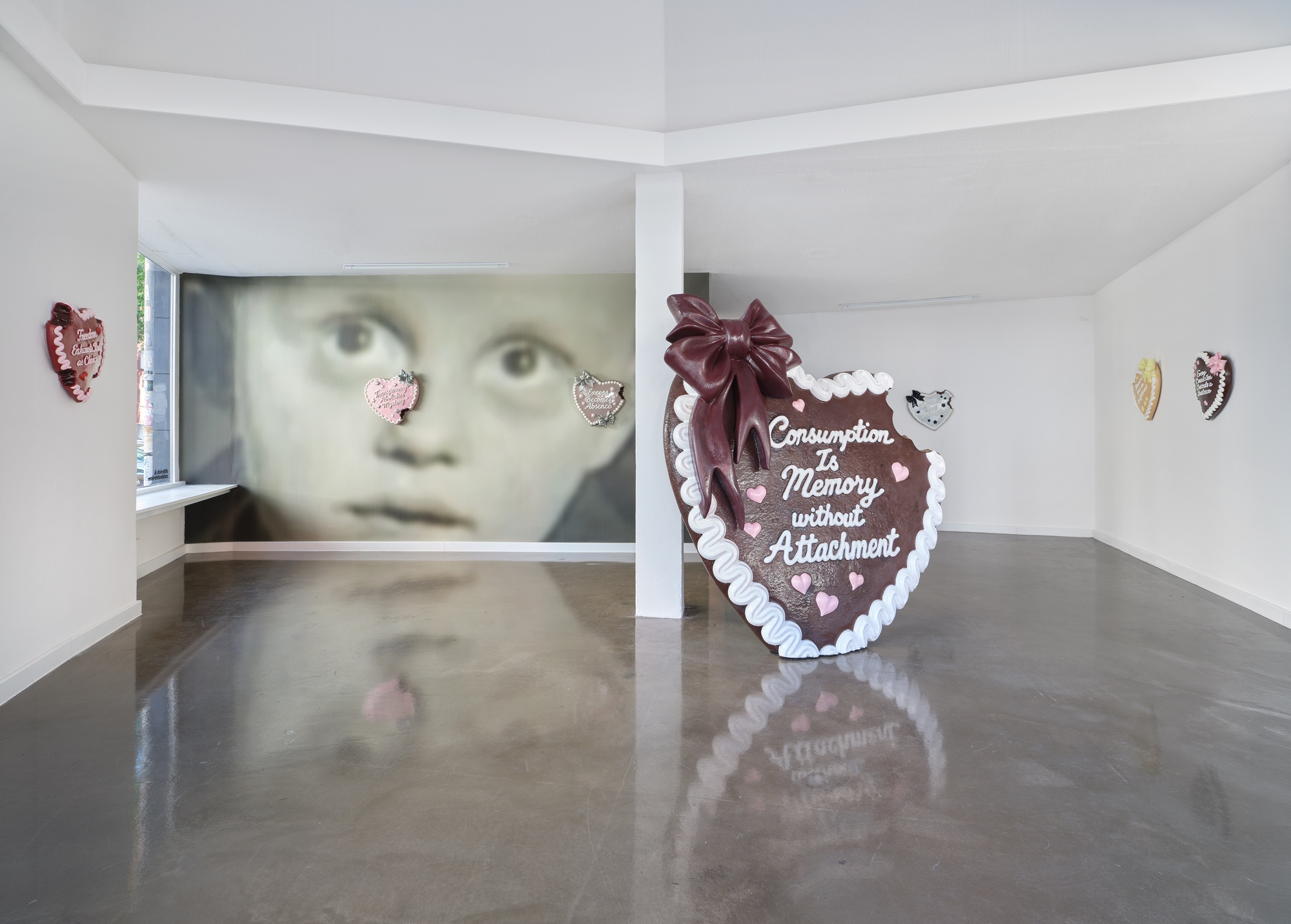
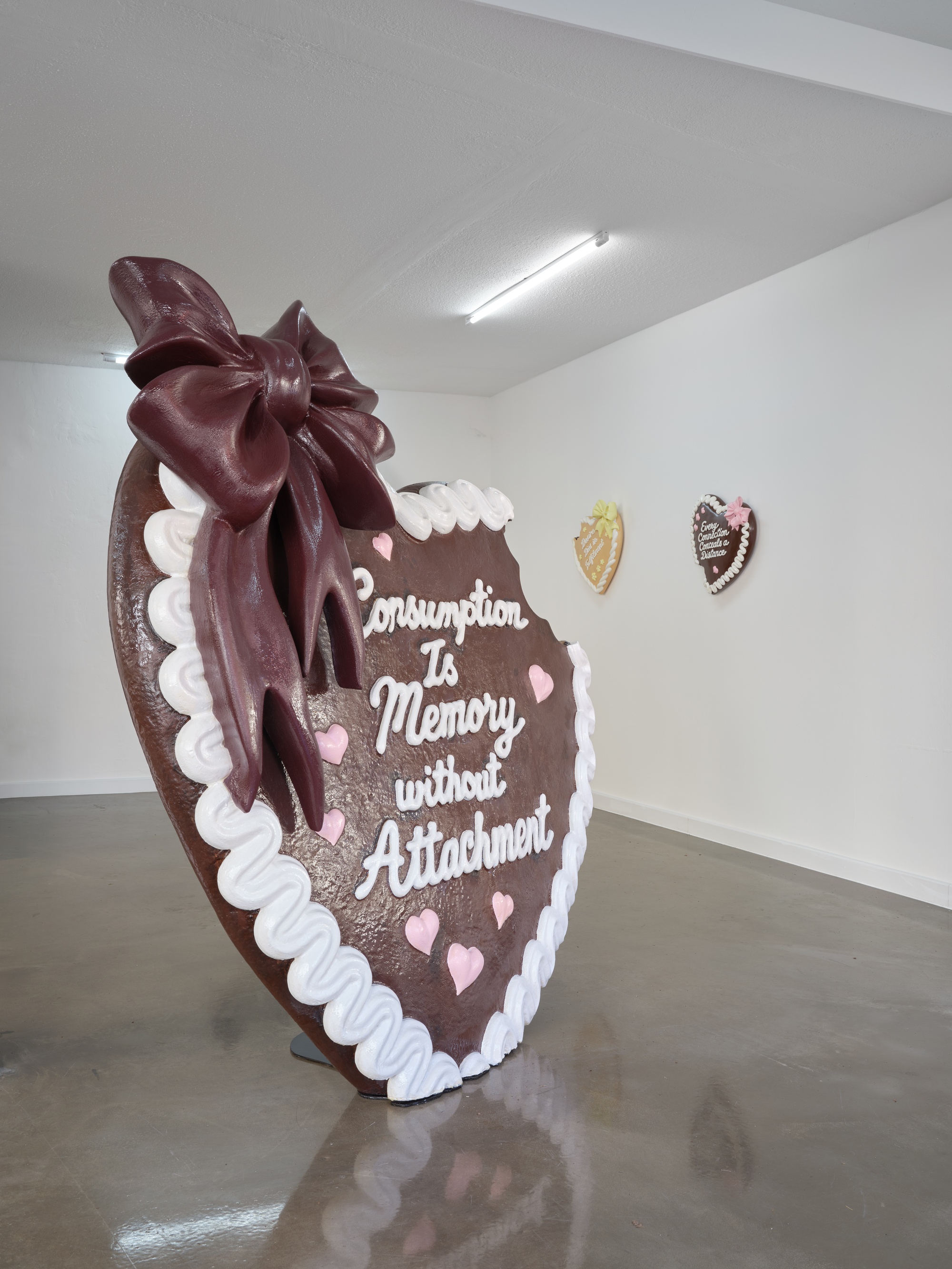
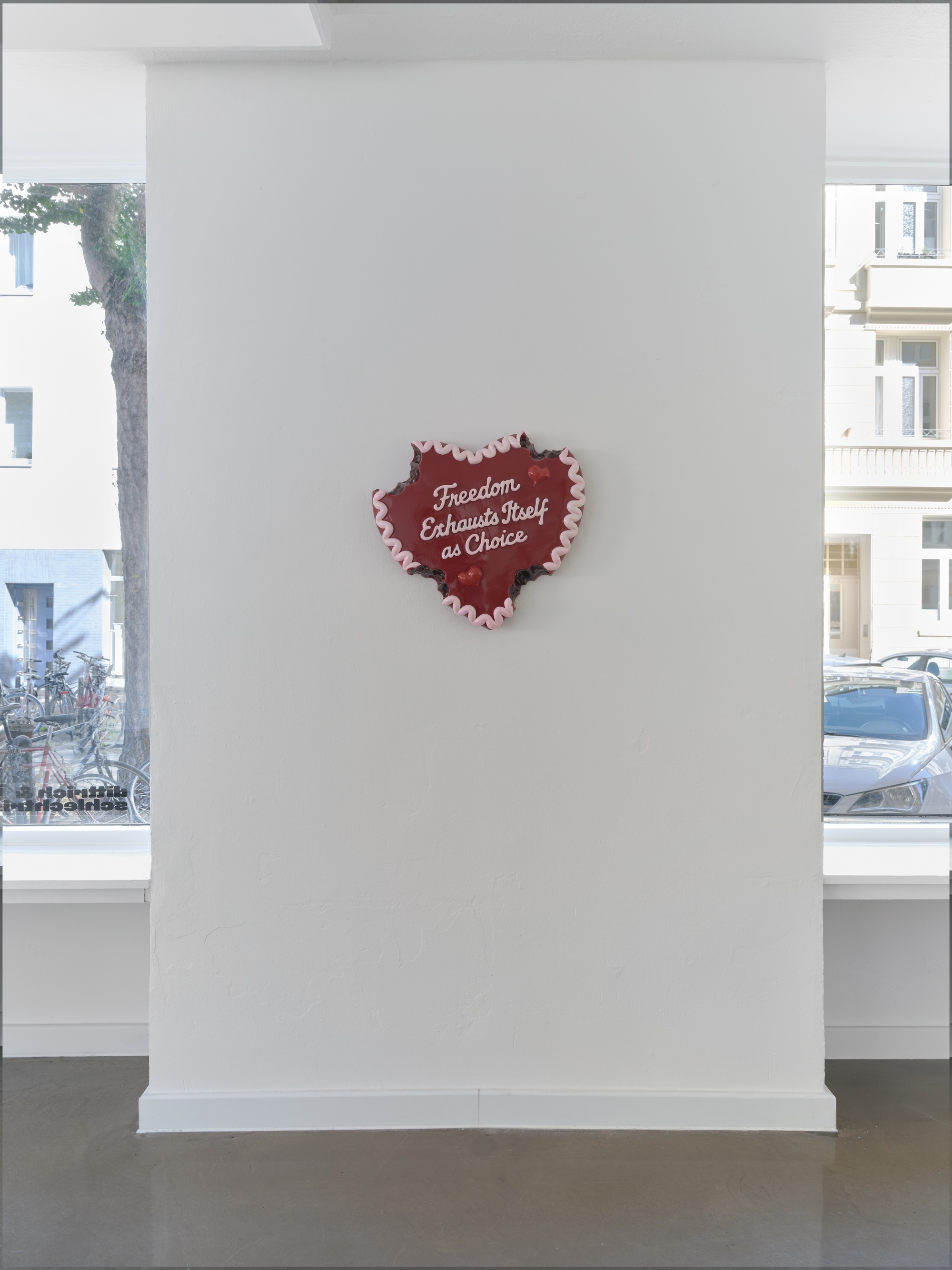
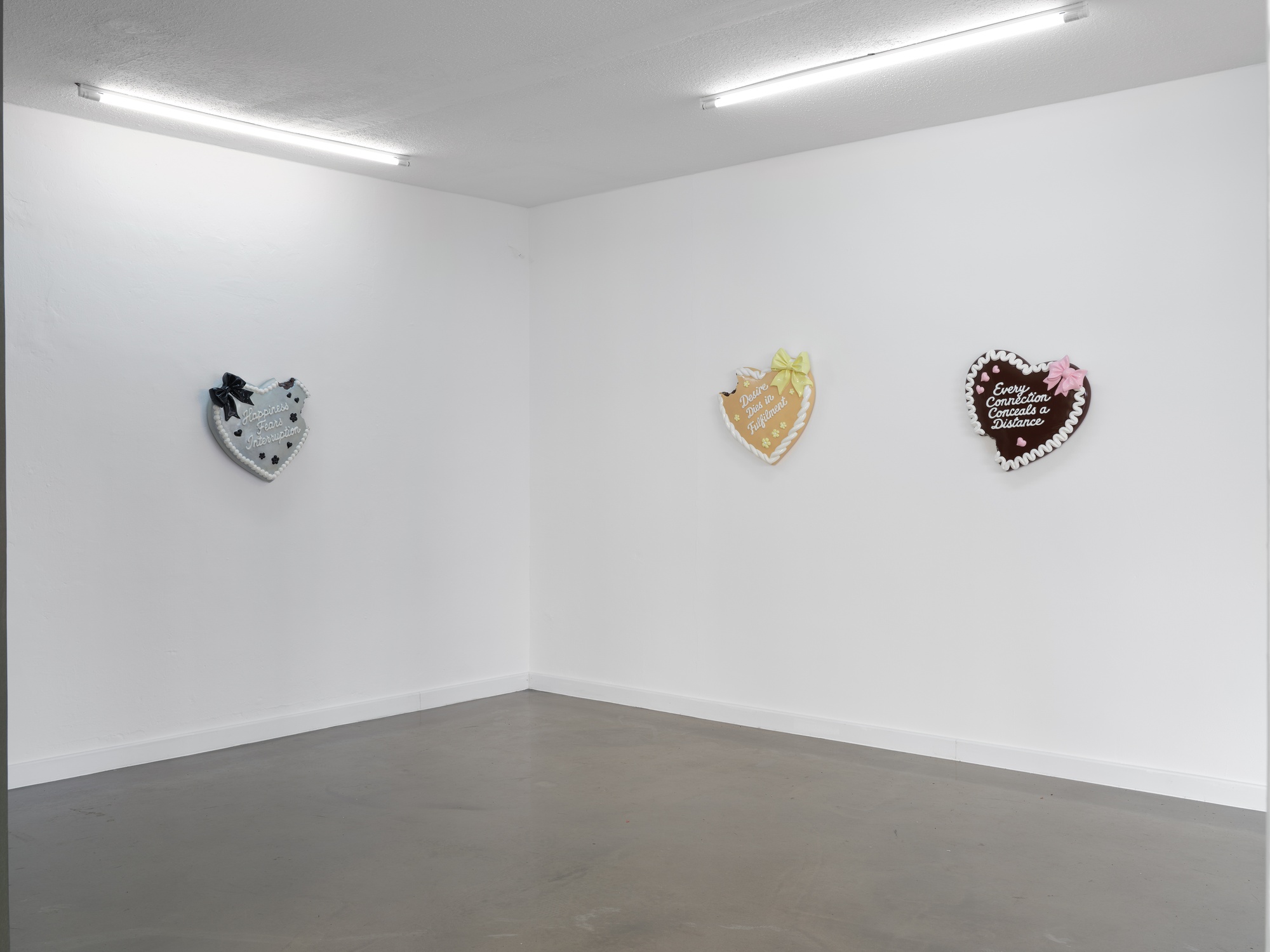
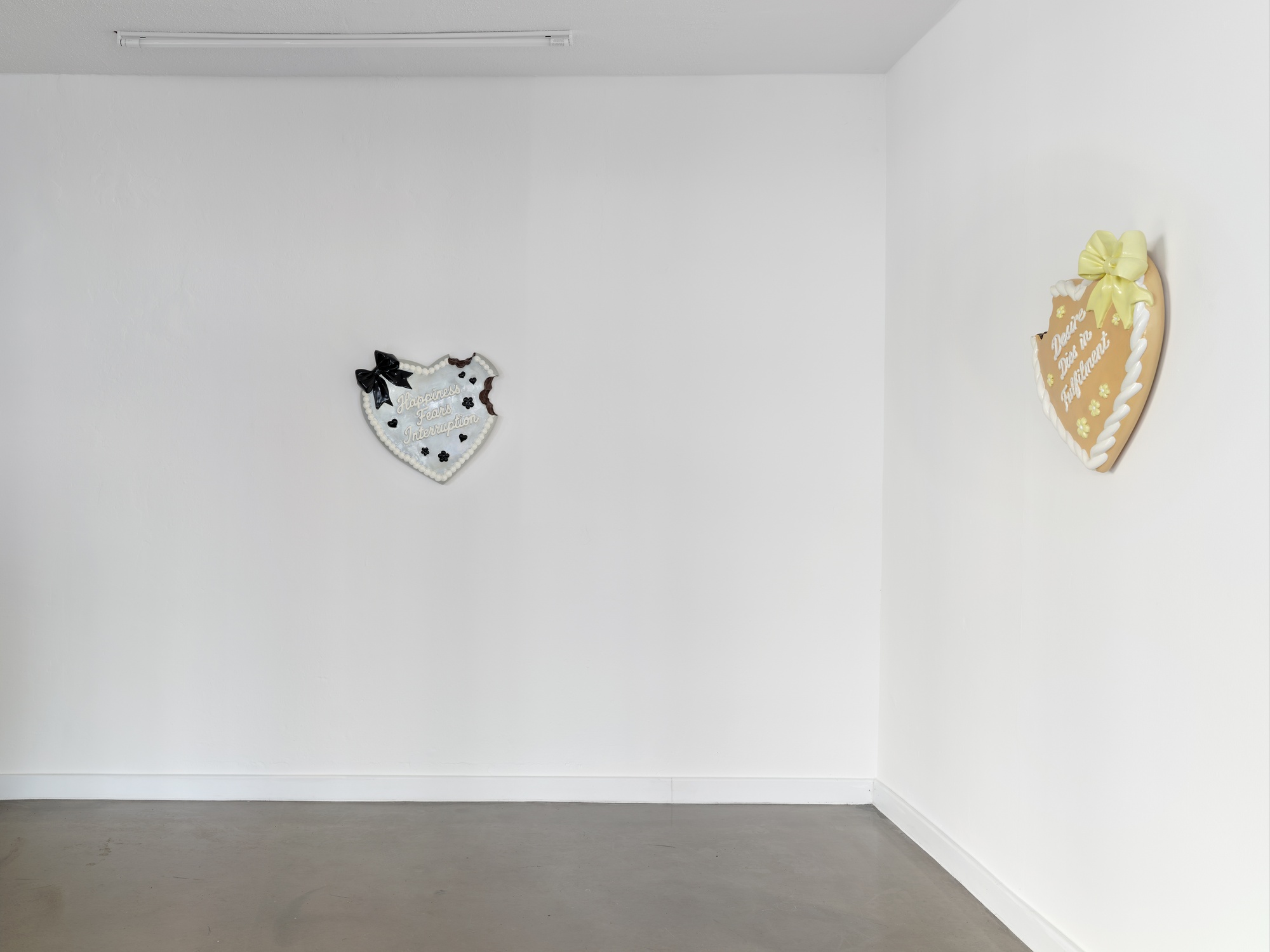
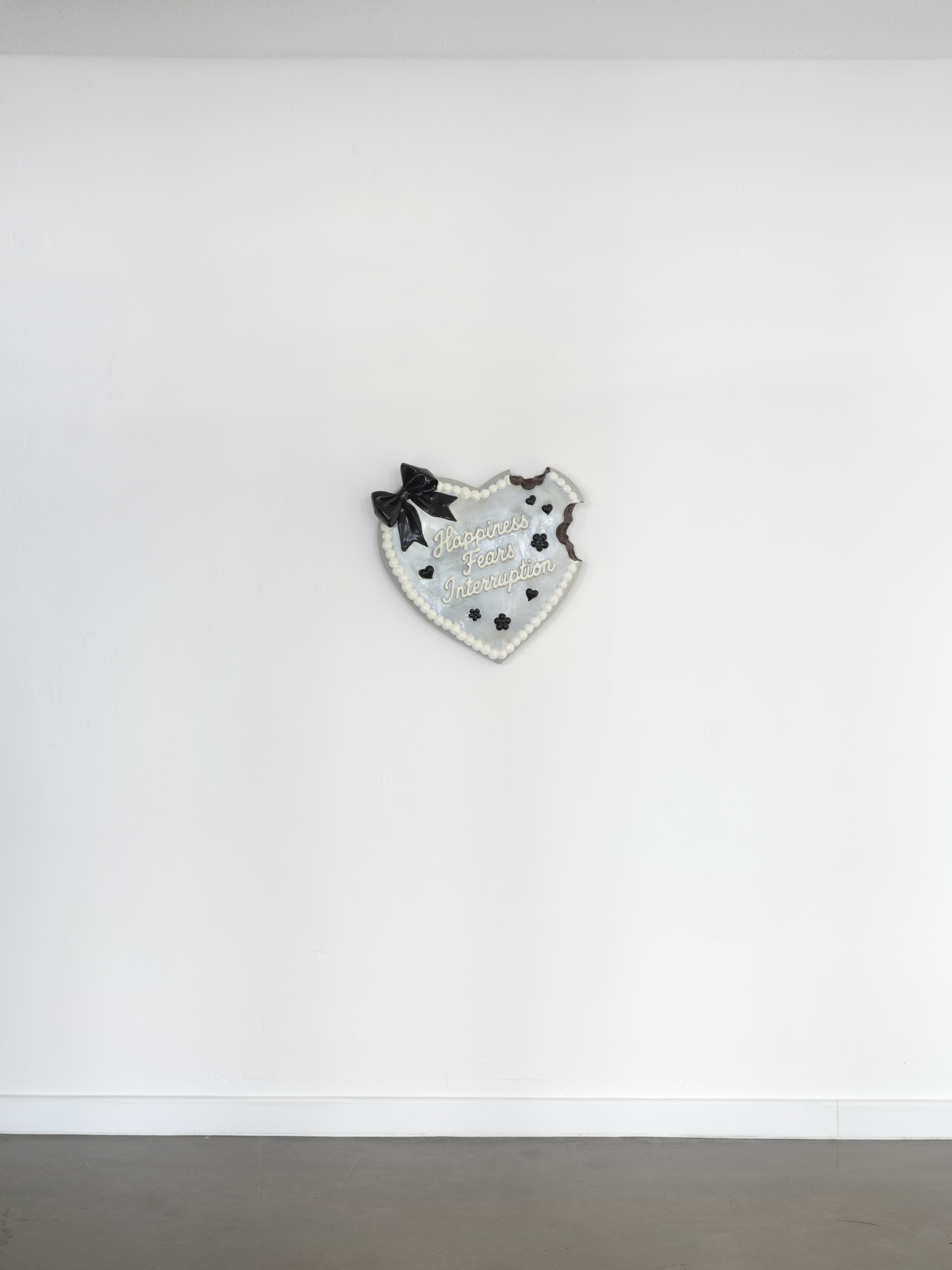
Czebatul continues this idea of incorporation in In This Economy?! with the gingerbread hearts from the series Love is Always Elsewhere and My Heart Goes Boom (both 2026). Short sentences appear in the sweetest icing aesthetic: Happiness Fears Interruption, Freedom Exhausts Itself as Choice, Desire Dies in Fulfilment, Every Connection Conceals a Distance. With enormous big-heartedness.[1] Even more oversized, Consumption is Memory without Attachment occupies the centre of the room.[2] All of it is apparently irresistibly delicious, as numerous bite marks testify.
As delicious as the aphorisms that not only popular philosophers such as Byung-Chul Han, but also political populists, serve up to us as sweets. Short slogans, emotional charge, repetition, easy consumption: political communication not infrequently makes use of the same means as the gingerbread wisdom of the fairground. In kitsch, feeling becomes a standardised commodity.
Theodor W. Adorno describes kitsch as the “pretence of feelings that do not exist” and as an art that “cannot or will not be taken seriously” and nevertheless claims aesthetic seriousness.[3] In Czebatul’s work, this diagnosis finds its materialisation. For kitsch needs no art-historical superstructure, no explanation, no intellectual legitimation. It is simply allowed to have its effect. A gingerbread heart says “love” and has to prove nothing to do so. Perhaps that is precisely where its seductive power lies. And one reason why art has always envied kitsch: it does without the burden of art history.
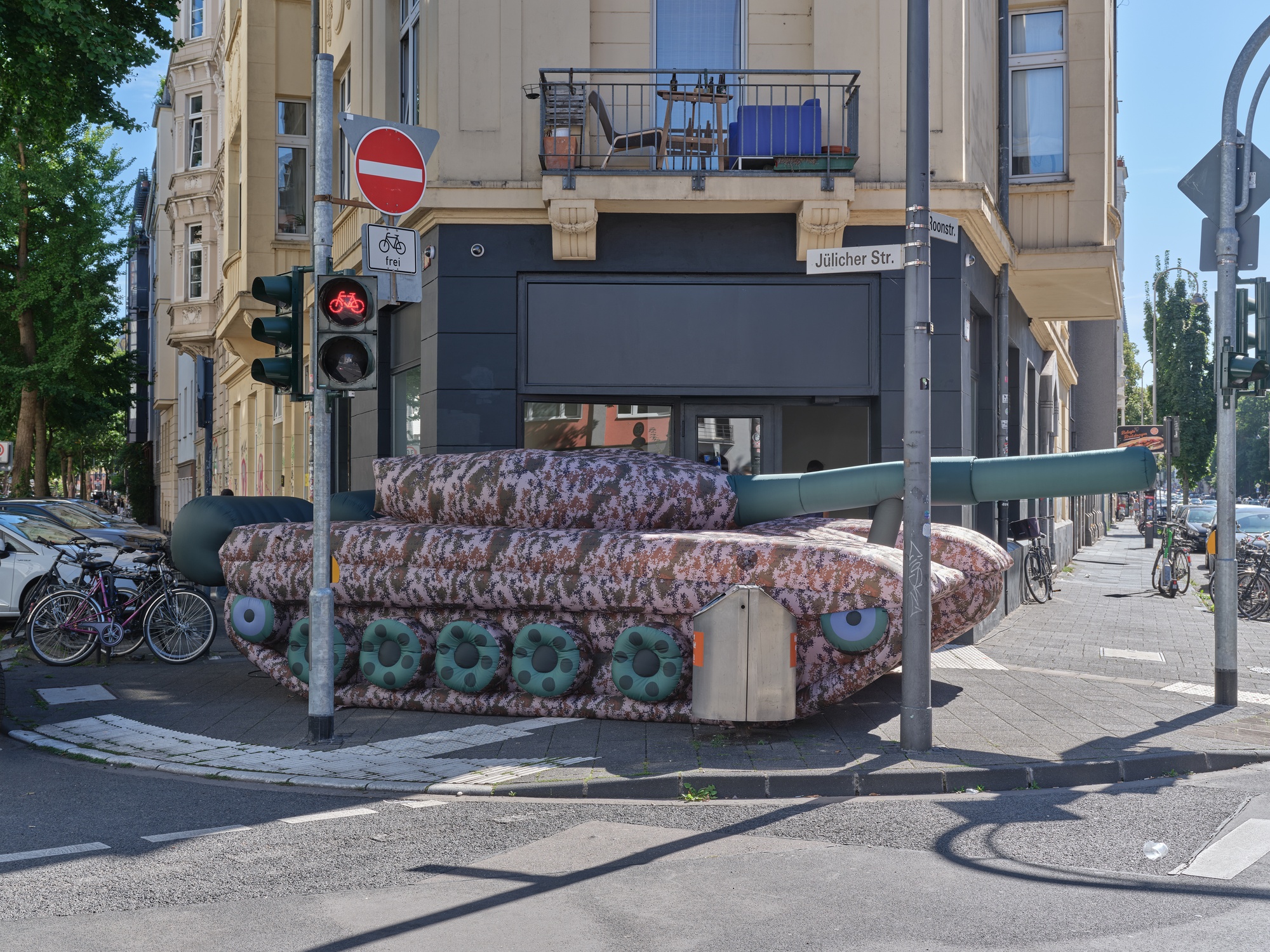
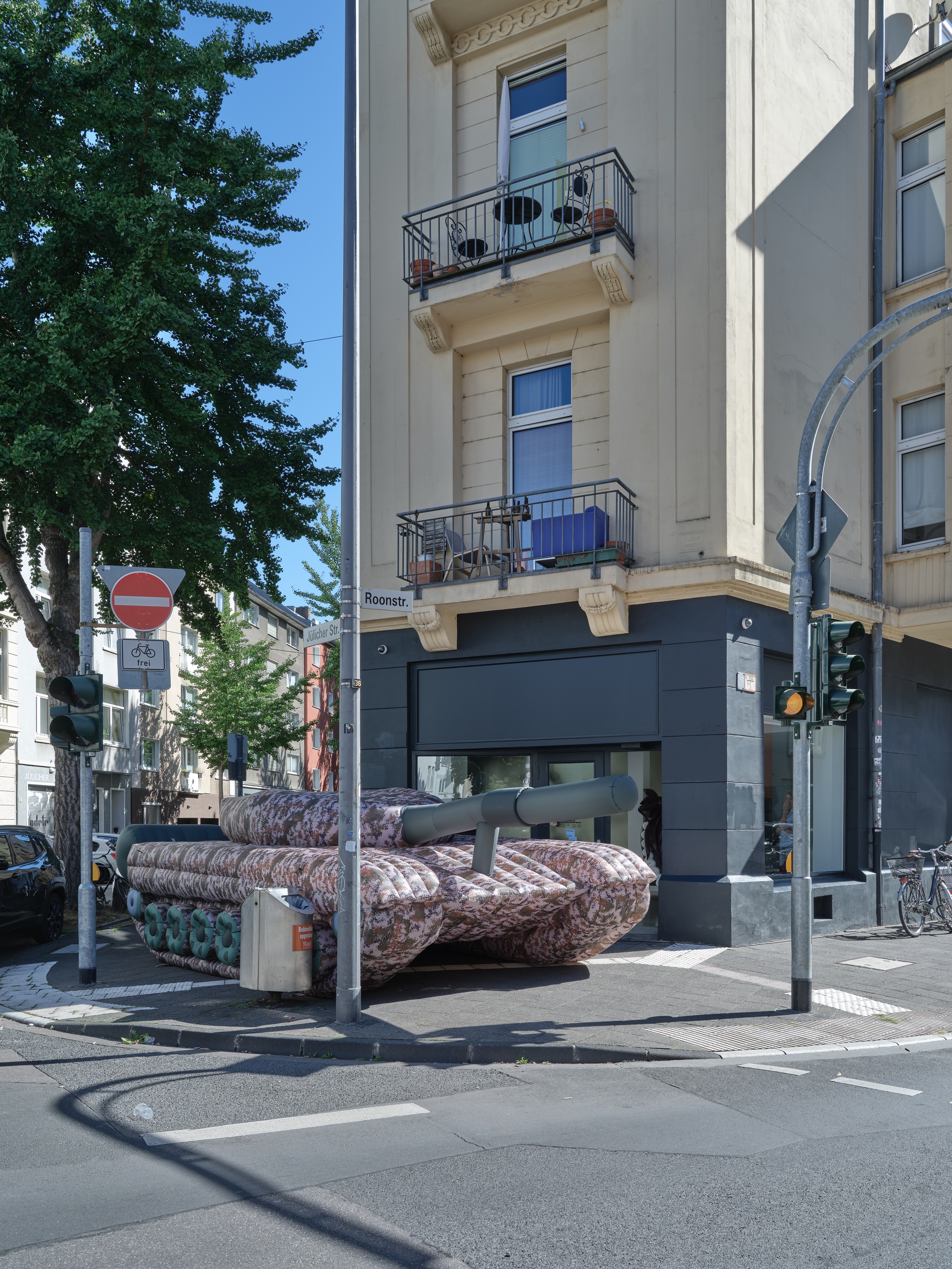
For Czebatul, the step from the fairground to war is only a small one. Not because the two worlds are the same, but because both work with images that promise something and put our perception to the test. Over the opening weekend, an inflatable tank decoy stands in front of the gallery. Fall for Me (2026) is modelled on the Leopard 2, one of Germany’s best-known main battle tanks, which is now also being used in Ukraine. The decoy is light, collapsible and reproducible – and transforms the symbol of military authority into an image of itself. Its effect depends on something being taken for real that is not.
In this way, Czebatul touches upon a strand of art history in which image-making and deception directly intersected. During the First World War, artists such as Lucien-Victor Guirand de Scévola and Louis Guingot developed camouflage techniques that employed insights from Impressionism and Cubism for military purposes. Norman Wilkinson developed “razzle dazzle”, geometric patterns intended to obscure the size, direction and speed of ships. And Ellsworth Kelly worked with the Ghost Army during the Second World War, which used inflatable tanks and other decoys to simulate imaginary troop movements.
What matters here is not the material reality of the object, but the image it produces. This is precisely where Czebatul’s ready-mades and transformations come close: she is interested, beyond this, in what a thing is “in itself”, and in what happens when it appears otherwise.
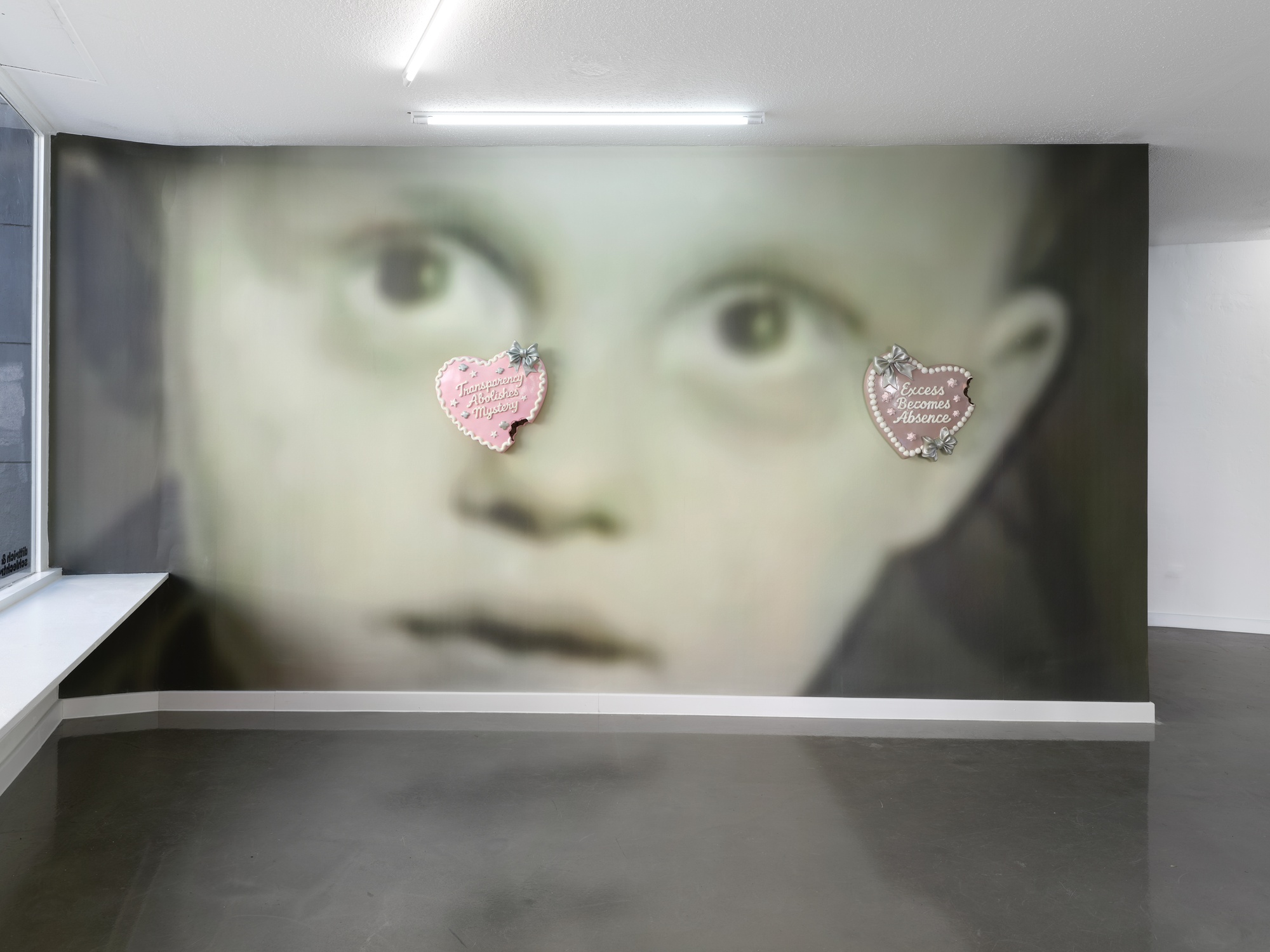
All that is kitschy, sugary, cute and childlike finally seems to gather in a large child’s face that dominates the room on a photographic mural. Fritzi (2026) shows the cherub-like, chubby face of a child with large, harmless-looking eyes. But the political themes so present at the moment, as well as the way in which they are communicated, also find their embodiment in this face. For beneath all its cuteness, it is Friedrich Merz, our current Federal Chancellor, transformed back into the little “Fritzi”. The image begins to slip as soon as one knows whom it depicts. The difference between the harmless image and the knowledge of the adult it depicts sets a process of shifting meaning in motion. The dreamily gazing cherub becomes a Chancellor who, in the public perception, is not exactly known for his communicative abilities or empathetic address.
The child’s face leads back to the mouth. In the oral phase, children explore their environment with their mouths, lips and tongues; at the same time, the muscles of the mouth are developed for later speech. The mouth is an organ of incorporation and articulation, of taking in nourishment and producing reality. Words make promises, generate fears, create belonging and construct images of the world. In Fritzi, these levels converge: the political subject appears as a childlike image, language becomes a question of seduction, and the private photograph becomes a form of public representation.
The exhibition thus returns to its opening question. Czebatul is interested in the peculiar proximity of mouth, language, incorporation, deception, and the production of reality. Her images, words and objects assert something and, precisely by doing so, reveal how such assertions function.
Czebatul’s displacements unsettle the familiar and reveal what has already accumulated within it. That is why her works do not need to articulate history in order to invoke it. She wisely avoids the obvious epigram History repeats Itself.[4] The associations with those terse phrases affixed to the entrance gates of the most terrible camps in German history arise involuntarily.
To paraphrase Marx, one might say that Zuzanna Czebatul, through her sculptures and installations, forces the petrified relations to dance by singing to them their own melody.[5] She isolates and displaces images, forms and words, transposes them into other materials, thereby bringing cultural sediments to speech and at the same time putting the supposedly self-evident up for discussion with a dry “Is that so?”.
[1] Unlike the standard dimensions of 15 × 15 to 25 × 25 cm, the works in the Love is Always Elsewhere series measure approximately 50 × 50 cm.
[2] Dimensions of the My Heart Goes Boom series: approximately 170 × 180 × 55 cm.
[3] „One of the defining elements of kitsch may well be the simulation of nonexistent feelings and thus their neutralization along with the neutralization of the aesthetic phenomenon. Kitsch is art that cannot be or does not want to be taken seriously and yet through its appearance postulates aesthetic seriousness.“ Theodor W. Adorno, Aesthetic Theory, trans. Robert Hullot-Kentor (Minneapolis: University of Minnesota Press, 1997), p. 315.
[4] “Hegel remarks somewhere that all great world-historic facts and personages appear, so to speak, twice. He forgot to add: the first time as tragedy, the second time as farce.” Karl Marx, The Eighteenth Brumaire of Louis Bonaparte, Chapter I., first Paragraph, 1852, Marxists Internet Archive, https://www.marxists.org/archive/marx/works/subject/hist-mat/18-brum/ch01.htm?utm_source=chatgpt.com, accessed on 24 August 2026.
[5] „Criticism dealing with this content is criticism in a hand-to-hand fight, and in such a fight the point is not whether the opponent is a noble, equal, interesting opponent, the point is to strike him. The point is not to let the Germans have a minute for self-deception and resignation. The actual pressure must be made more pressing by adding to it consciousness of pressure, the shame must be made more shameful by publicizing it. Every sphere of German society must be shown as the partie honteuse of German society: these petrified relations must be forced to dance by singing their own tune to them! The people must be taught to be terrified at itself in order to give it courage. This will be fulfilling an imperative need of the German nation, and the needs of the nations are in themselves the ultimate reason for their satisfaction.“ Karl Marx, A Contribution to the Critique of Hegel’s Philosophy of Right: Introduction, first published in the Deutsch-Französische Jahrbücher, 7 & 10 February 1844, Marxists Internet Archive, https://www.marxists.org/archive/marx/works/1843/critique-hpr/intro.htm, accessed on 24 August 2026.
German
Is That So?!
In This Economy?! Mit diesem geradezu aphoristischen Kommentar eröffnet Zuzanna Czebatul ihre Einzelausstellung bei Dittrich & Schlechtriem in Köln. Man könnte ihm einen weiteren, sehr trockenen, höflich-ironischen Nicht-Kommentar folgen lassen, etwa: „Is that so?“. Denn der höchst zeitgemäße Bonmot, der als Ausstellungstitel dient, ist eigentlich gar keine Frage. Schon gar keine Frage danach, was unter den gegenwärtigen wirtschaftlichen Bedingungen möglich ist. Vielmehr handelt es sich um eine sehr vage Andeutung einer großen Bandbreite möglicher Haltungen. Die Interpretation wird damit an das Gegenüber delegiert. Und genau darin liegt der Ausgangspunkt für Czebatuls Auseinandersetzung damit, wie Gleichgültigkeit, eine unverkennbare Vielzahl an Wahlmöglichkeiten und eine unüberschaubare Menge an Informationen dazu führen, dass einfache Antworten und Slogans so beruhigend und verführerisch wirken. Grundlegender noch fragt sie danach, wie wir unter diesen wirtschaftlichen, politischen, kulturellen und gesellschaftlichen Bedingungen sprechen, begehren, kommunizieren und uns darstellen.
Der Ausstellungstitel verweist bereits auf eine Methode, die für Czebatuls skulpturale Praxis zentral ist: Sie nimmt vertraute Bilder, Formen und Zeichen und verschiebt sie. Sie vergrößert, verflüssigt oder rematerialisiert sie, entzieht sie ihrem Kontext und lässt sie dadurch zugleich vertraut und fremd erscheinen. So entstehen skulpturale Doppelgänger, in denen das Ausgangsobjekt weiterlebt, während seine Bedeutung ins Rutschen gerät. Was zunächst eindeutig erscheint, erweist sich als abhängig von Maßstab, Material, Kontext und kultureller Prägung.
Czebatul interessiert sich für die Sprachen und Zeichensysteme, die uns im Alltag umgeben: für Populärkultur ebenso wie für kunsthistorisch aufgeladene Formen, für Slogans ebenso wie für politische Bilder. Ihre Arbeiten zeigen, dass Repräsentation niemals unschuldig ist. Ein Bild bildet etwas nicht einfach ab; es erzeugt Vorstellungen davon, was etwas ist. Und je einfacher und vertrauter ein Zeichen erscheint, desto leichter kann es sich als Wahrheit etablieren.
Sprache ist ein kontinuierliches Element in Czebatuls Arbeit. Für sie sind Wörter keine neutralen Informationsträger, sondern visuelle, affektive und politische Werkzeuge. Sie erzeugen Begehren, Zugehörigkeit und Wirklichkeiten. Was geschieht, wenn eine Botschaft zu einem Konsumobjekt wird? Wann wird eine persönliche Aussage öffentlich? Und warum sind wir so empfänglich für Verführung?
Eine ihrer bekanntesten Serien ist Macromolecule Exploiting Some Biological Target, eine seit 2021 fortlaufend erweiterte Reihe übergroßer, aufblasbarer Ecstasy-Tabletten. Die monumentalen Pillen lassen sich als Denkmäler der Rave-Kultur lesen: als Bilder von Gemeinschaft, Befreiung und hedonistischer Rebellion, aber auch einer Subkultur, die längst zur Ware geworden ist. Czebatul bläst die Pille buchstäblich auf und verwandelt das Konsumobjekt in ein Monument. „Rush“, „Revolution“, „Worldwide“, „Error“: Die darauf gedruckten Wörter, wie auf echten MDMA-Pillen, oszillieren zwischen Versprechen und Ernüchterung.
Czebatul führt diesen Gedanken der Einverleibung in In This Economy?! mit den Lebkuchenherzen aus den Serien Love is Always Elsewhere und My Heart Goes Boom (beide 2026) weiter. Kurze Sätze erscheinen in der süßesten Zuckergussästhetik: Happiness Fears Interruption, Freedom Exhausts Itself as Choice, Desire Dies in Fulfilment, Every Connection Conceals a Distance. Mit enormer Herzlichkeit.[1] Noch überdimensionierter nimmt Consumption is Memory without Attachment die Mitte des Raumes ein.[2] Alles davon wirkt offenbar unwiderstehlich köstlich, wie zahlreiche Bissspuren bezeugen.
So köstlich wie die Aphorismen, die uns nicht nur populäre Philosophen wie Byung-Chul Han, sondern auch politische Populisten als Süßigkeiten servieren. Kurze Slogans, emotionale Aufladung, Wiederholung, leichte Konsumierbarkeit: Politische Kommunikation bedient sich nicht selten derselben Mittel wie die Lebkuchenweisheiten vom Jahrmarkt. Im Kitsch wird Gefühl zu einer standardisierten Ware.
Theodor W. Adorno beschreibt Kitsch als die „Vortäuschung von Gefühlen, die nicht existieren“ und als eine Kunst, die „nicht ernst genommen werden kann oder will“ und dennoch ästhetischen Ernst beansprucht.[3] In Czebatuls Arbeit findet diese Diagnose ihre Materialisierung. Denn Kitsch braucht keinen kunsthistorischen Überbau, keine Erklärung, keine intellektuelle Legitimation. Er darf einfach wirken. Ein Lebkuchenherz sagt „Liebe“ und muss dafür nichts beweisen. Vielleicht liegt genau darin seine Verführungskraft. Und vielleicht ist dies ein Grund dafür, dass die Kunst den Kitsch seit jeher beneidet: Er kommt ohne die Last der Kunstgeschichte aus.
Für Czebatul ist der Schritt vom Jahrmarkt zum Krieg nur ein kleiner. Nicht, weil die beiden Welten dasselbe wären, sondern weil beide mit Bildern arbeiten, die etwas versprechen und unsere Wahrnehmung auf die Probe stellen. Über das Eröffnungswochenende steht vor der Galerie ein aufblasbarer Panzerdummy. Fall for Me (2026) ist dem Leopard 2 nachempfunden, einem der bekanntesten deutschen Kampfpanzer, der inzwischen auch in der Ukraine eingesetzt wird. Der Dummy ist leicht, zusammenfaltbar und reproduzierbar – und verwandelt das Symbol militärischer Autorität in ein Bild seiner selbst. Seine Wirkung beruht darauf, dass etwas für echt gehalten wird, das es nicht ist.
Damit berührt Czebatul einen Strang der Kunstgeschichte, in dem Bildproduktion und Täuschung unmittelbar ineinandergreifen. Während des Ersten Weltkriegs entwickelten Künstler wie Lucien-Victor Guirand de Scévola und Louis Guingot Tarntechniken, die Erkenntnisse des Impressionismus und Kubismus für militärische Zwecke nutzten. Norman Wilkinson entwickelte „razzle dazzle“, geometrische Muster, die Größe, Richtung und Geschwindigkeit von Schiffen verschleiern sollten. Und Ellsworth Kelly arbeitete während des Zweiten Weltkriegs mit der Ghost Army, die aufblasbare Panzer und andere Attrappen einsetzte, um imaginäre Truppenbewegungen zu simulieren.
Entscheidend ist hier nicht die materielle Realität des Objekts, sondern das Bild, das es erzeugt. Genau hier kommen Czebatuls Readymades und Transformationen ins Spiel: Darüber hinaus interessiert sie sich dafür, was ein Ding „an sich“ ist und was geschieht, wenn es anders erscheint.
Alles, was kitschig, zuckrig, niedlich und kindlich ist, scheint schließlich in einem großen Kindergesicht zusammenzulaufen, das den Raum auf einem fotografischen Wandbild dominiert. Fritzi (2026) zeigt das cherubische, pausbäckige Gesicht eines Kindes mit großen, harmlos wirkenden Augen. Doch auch die derzeit so präsenten politischen Themen sowie die Art und Weise, wie sie kommuniziert werden, finden in diesem Gesicht ihre Verkörperung. Denn unter all seiner Niedlichkeit verbirgt sich Friedrich Merz, unser derzeitiger Bundeskanzler, zurückverwandelt in den kleinen „Fritzi“. Das Bild beginnt zu kippen, sobald man weiß, wen es darstellt. Der Unterschied zwischen dem harmlosen Bild und dem Wissen um den Erwachsenen, den es zeigt, setzt einen Prozess der Bedeutungsverschiebung in Gang. Aus dem verträumt blickenden Cherub wird ein Bundeskanzler, der in der öffentlichen Wahrnehmung nicht gerade für seine kommunikativen Fähigkeiten oder eine empathische Ansprache bekannt ist.
Das Kindergesicht führt zurück zum Mund. In der oralen Phase erkunden Kinder ihre Umwelt mit Mund, Lippen und Zunge; zugleich werden die Muskeln des Mundes für das spätere Sprechen entwickelt. Der Mund ist ein Organ der Einverleibung und Artikulation, der Nahrungsaufnahme und der Erzeugung von Wirklichkeit. Wörter machen Versprechen, erzeugen Ängste, schaffen Zugehörigkeit und konstruieren Weltbilder. In Fritzi laufen diese Ebenen zusammen: Das politische Subjekt erscheint als kindliches Bild, Sprache wird zur Frage der Verführung und die private Fotografie zu einer Form öffentlicher Repräsentation.
Die Ausstellung kehrt damit zu ihrer Ausgangsfrage zurück. Czebatul interessiert sich für die eigentümliche Nähe von Mund, Sprache, Einverleibung, Täuschung und Wirklichkeitsproduktion. Ihre Bilder, Wörter und Objekte behaupten etwas und legen gerade dadurch offen, wie solche Behauptungen funktionieren.
Czebatuls Verschiebungen bringen das Vertraute aus dem Gleichgewicht und legen offen, was sich bereits in ihm angesammelt hat. Deshalb müssen ihre Arbeiten Geschichte nicht ausdrücklich formulieren, um sie aufzurufen. Klugerweise verzichtet sie auf das naheliegende Epigramm History repeats Itself.[4] Die Assoziationen zu jenen knappen Sätzen, die an den Eingangstoren der schrecklichsten Lager der deutschen Geschichte angebracht waren, stellen sich unwillkürlich ein.
In Anlehnung an Marx könnte man sagen, dass Zuzanna Czebatul durch ihre Skulpturen und Installationen die versteinerten Verhältnisse zum Tanzen zwingt, indem sie ihnen ihre eigene Melodie vorsingt.[5] Sie isoliert und verschiebt Bilder, Formen und Wörter, überträgt sie in andere Materialien und bringt dadurch kulturelle Sedimente zum Sprechen – während sie zugleich das vermeintlich Selbstverständliche mit einem trockenen „Is that so?“ zur Diskussion stellt.
[1] Im Gegensatz zu den üblichen Maßen von 15 × 15 bis 25 × 25 cm messen die Arbeiten der Serie Love is Always Elsewhere etwa 50 × 50 cm.
[2] Maße der Serie My Heart Goes Boom: etwa 170 × 180 × 55 cm.
[3] „Eines der bestimmenden Elemente des Kitsches dürfte die Simulation nicht vorhandener Gefühle und damit deren Neutralisierung zusammen mit der Neutralisierung des ästhetischen Phänomens sein. Kitsch ist Kunst, die nicht ernst genommen werden kann oder will und dennoch durch ihr Auftreten ästhetischen Ernst postuliert.“ Theodor W. Adorno, Ästhetische Theorie, übers. Robert Hullot-Kentor (Minneapolis: University of Minnesota Press, 1997), S. 315.
[4] „Hegel remarks somewhere that all great world-historic facts and personages appear, so to speak, twice. He forgot to add: the first time as tragedy, the second time as farce.“ Karl Marx, The Eighteenth Brumaire of Louis Bonaparte, Kapitel I, erster Absatz, 1852, Marxists Internet Archive, https://www.marxists.org/archive/marx/works/subject/hist-mat/18-brum/ch01.htm?utm_source=chatgpt.com, abgerufen am 24. August 2026.
[5] „Criticism dealing with this content is criticism in a hand-to-hand fight, and in such a fight the point is not whether the opponent is a noble, equal, interesting opponent, the point is to strike him. The point is not to let the Germans have a minute for self-deception and resignation. The actual pressure must be made more pressing by adding to it consciousness of pressure, the shame must be made more shameful by publicizing it. Every sphere of German society must be shown as the partie honteuse of German society: these petrified relations must be forced to dance by singing their own tune to them! The people must be taught to be terrified at itself in order to give it courage. This will be fulfilling an imperative need of the German nation, and the needs of the nations are in themselves the ultimate reason for their satisfaction.“ Karl Marx, A Contribution to the Critique of Hegel’s Philosophy of Right: Introduction, erstmals veröffentlicht in den Deutsch-Französischen Jahrbüchern, 7. & 10. Februar 1844, Marxists Internet Archive, https://www.marxists.org/archive/marx/works/1843/critique-hpr/intro.htm, abgerufen am 24. August 2026.