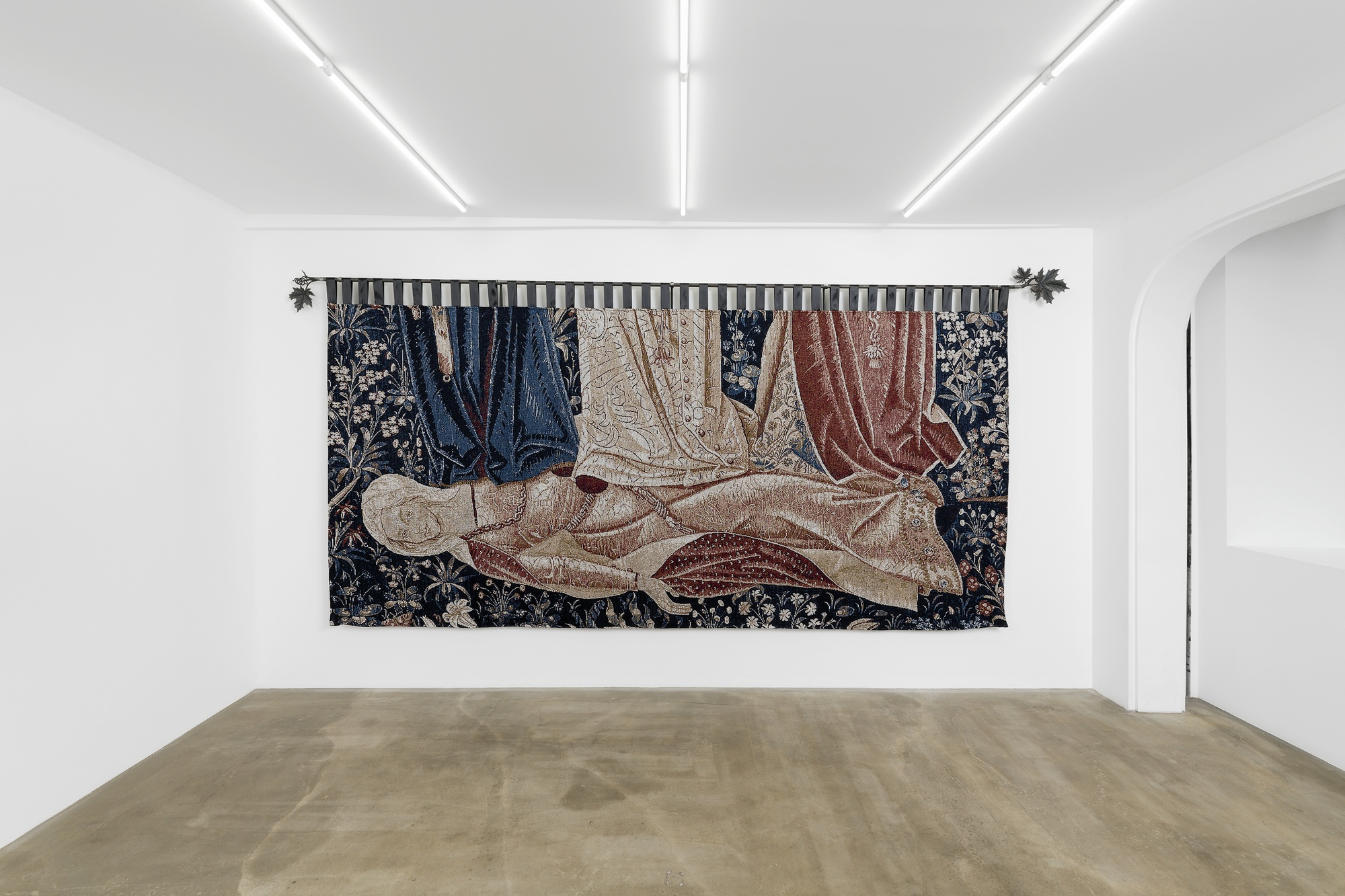
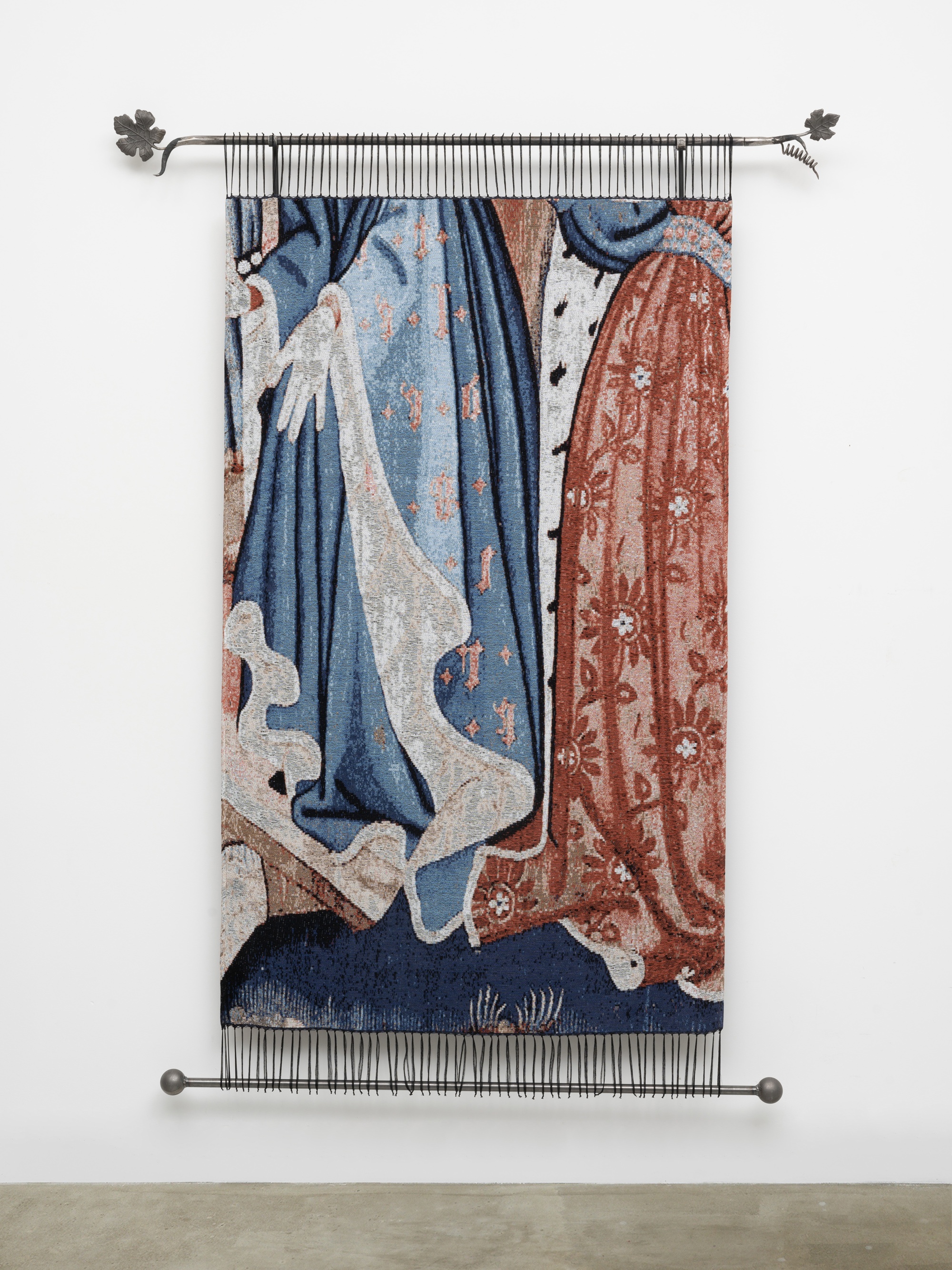
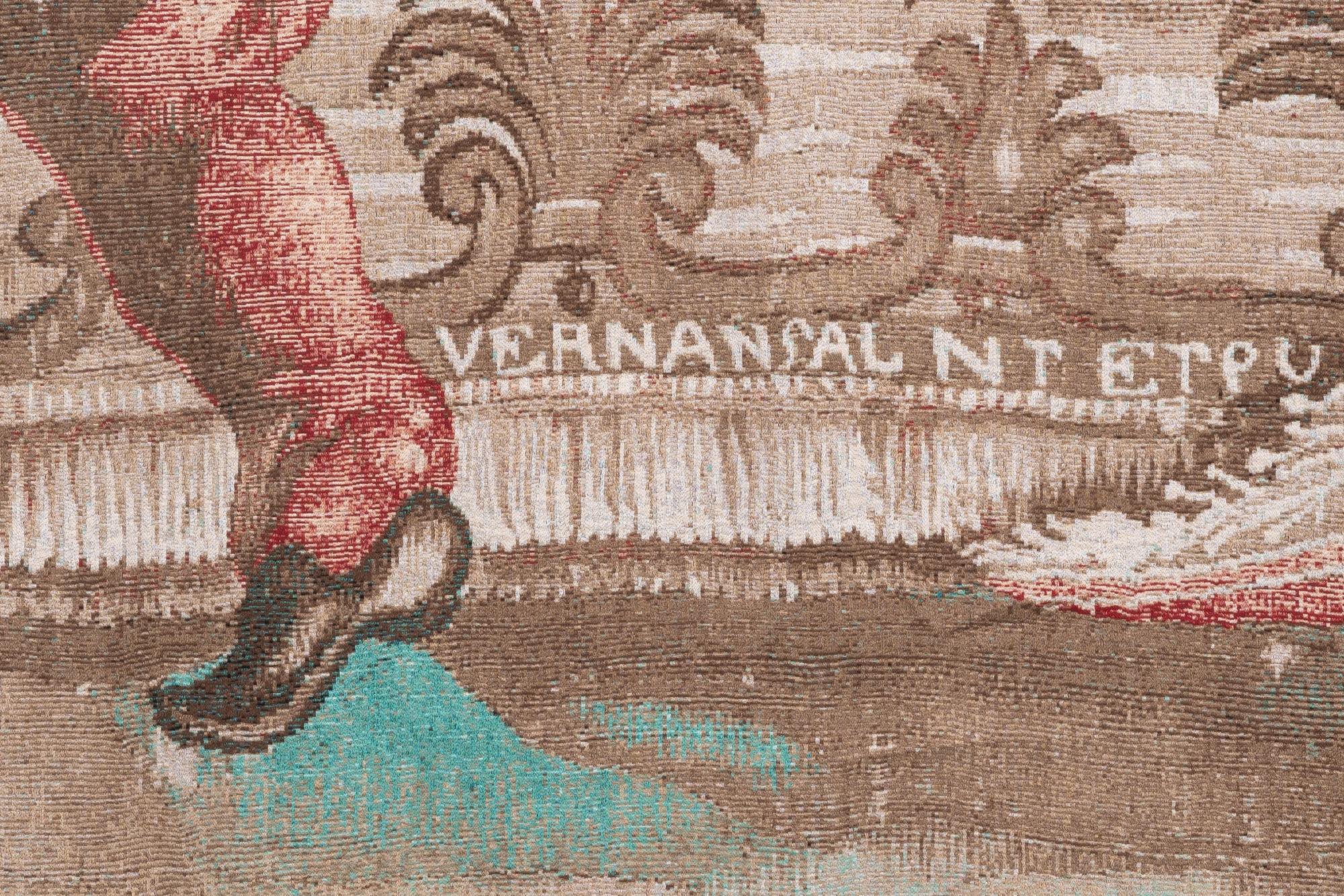
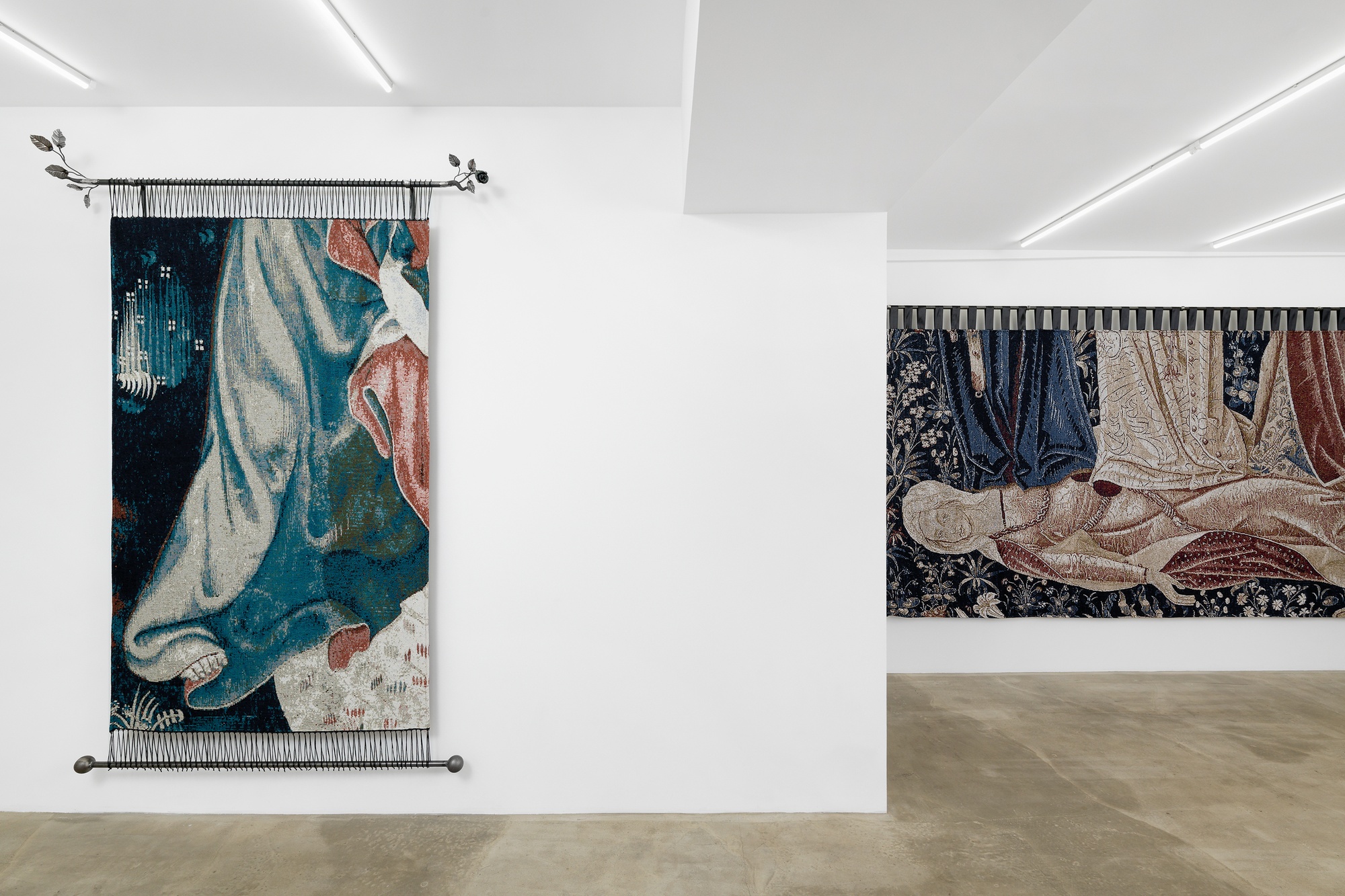
A Million Threads Still Weaving (Vour Veils)
Installation View, 2023
A Million Threads Still Weaving (Red & Blue Veil)
Installation View, 2023
A Million Threads Still Weaving (Red Sock)
Installation View, 2023
A Million Threads Still Weaving (Green Veil)
Installation View, 2023
The Lunatic Fringe, sans titre Gallery, Paris
Scroll Down for German
The reality and reliability of the human world rest primarily on the fact that we are surrounded by things more permanent than the activity by which they are produced, and potentially even more permanent than the lives of the authors.” – Hannah Arendt on The Human Condition
For her second exhibition at Sans titre, Zuzanna Czebatul presents a new series of monumental tapestries and floor-based sculptural pieces. If Czebatul has produced fabric works in the past - one thinks, notably, of the carpet that covered the entry hall of the Cologne art fair in 2018 - tapestry is a new medium for the artist, who pursues upon it her reflections on hegemonic western power structures. With an openly feminist and queer perspective, the artist takes interest in the manner in which our thoughts are constructed by narratives that have been handed-down to us, and by those that we recount in turn.
As with other previous works, Czebatul dips once more into art history to capture our present conditions. The images represented on each textile work are blown-up details of ancient tapestries, dating from the Middle Ages to roughly AD 1600. These close-ups are concentrated on the lower parts of the compositions, at times allowing a glimpse of a foot, a fetishist motif with a long iconographic tradition. For Czebatul, who previously reproduced the foot of the sculpture of the Bismarck national monument in Berlin’s Tiergarten, the foot is a symbol of patriarchal power and systemic violence. It’s also an image of mobility, not only that of bodies, but also that of cultures, knowledges, and crafts, as exemplified by the art of tapestry, a medium that circulated throughout Europe and beyond, hybridizing along the way. The enlargements focus the gaze on details of robes or draperies, which creates an illusion of volume and provokes a sort of mise en abyme effect, of textile represented by textile.
The close-ups were drafted from reproductions, often of low resolution, found in books or on the internet, which Czebatul then reproduced again at a large scale. From the second to the third dimension, from the analog to the digital, these transitions enacted by the artist recall that every image, as polished as it might seem, possesses a material structure and is fabricated, whether by the artisans of the past or by the machines of today. Deconstructing the material characteristics of ancient works is above all, for Czebatul, a way to reveal the hidden meanings of cultural symbols.
Historically, tapestries in castles had an acoustic function, insulating rooms of great dimensions. They were thus directly linked to the architecture of sites where they were exhibited. Like the paintings with which they shared the walls, they were markers of power and wealth and attested to the politics of their epoch and the allegiances of their owners. But contrary to paintings that served the same function of testimony or propaganda, tapestries could easily be rolled up and stored, in such a way that they were often replaced with others. Owners had new tapestries made to follow changing fashions but also to transmit new beliefs or ideologies. The Gobelins Manufactory in Paris thus participated in the history of the monarchies and the formation of national identities. Today still, decoration and architecture are intimately connected and form structures of domination that condition our perceptions and our actions. Inside Sans titre, the new tapestries have a disproportionate size and their outdated grandiloquence undermines the authority of the “white cube.”
On the floor, colored cement forms recall the flooring of a church or cathedral. Czebatul draws inspiration from an ancient technique called opus sectile that consists of using pieces of cut marble to create decorative pavements. Widely used during the Roman Empire, this marble marquetry was a prestigious artistic technique, signaling opulence and power. Just as her fragments of ancient tapestries were reproduced with digital and industrial techniques, Czebatul employs here a cheap mass production material - cement - to create a trompe-l’oeil marble effect. The shapes of the pieces on the floor are inspired by the biomorphic forms of Jean Arp. If the latter were produced through chance and intuition, those of Czebatul are entirely premeditated.
In the exhibition, works and techniques from the past with auratic power are presented as trompe-l’oeil, or fragmentary facsimiles. Czebatul appropriates loaded symbols and questions the pretense of the original to remind us of the transformational power of things - for the better or for the worse, as in the case of historical revisionism. The expression “lunatic fringe” that the artist chose for her title describes a minority with irrational beliefs. It was notably used by Theodor Adorno to speak of rightwing extremists. According to the philosopher, deviant or pathological ideas of this “lunatic fringe” are not so distinct from the opinion of the masses, but in reality form an integral part of it. Extremism in this sense is no more than a symptom of an underlying dysfunctional system. In refering to this idea of one of the founders of the Frankfurt school, Czebatul suggests that extremism lives at the heart of our histories and in our most expensive decor.
Devrim Bayar
German
„Die Realität und Verlässlichkeit der menschlichen Welt beruhen in erster Linie darauf, dass wir von Dingen umgeben sind, die beständiger sind als die Aktivität, durch die sie geschaffen wurden, und potenziell sogar beständiger als das Leben ihrer Urheber.“ – Hannah Arendt über The Human Condition
Für ihre zweite Ausstellung bei Sans titre präsentiert Zuzanna Czebatul eine neue Serie monumentaler Wandteppiche und bodenbasierter Skulpturen. Während Czebatul bereits in der Vergangenheit mit Textilarbeiten gearbeitet hat – man denke etwa an den Teppich, der 2018 die Eingangshalle der Kölner Kunstmesse bedeckte – ist der Wandteppich ein neues Medium für die Künstlerin, auf dem sie ihre Reflexionen über hegemoniale westliche Machtstrukturen fortführt. Mit einer offen feministischen und queeren Perspektive interessiert sich die Künstlerin dafür, wie unsere Gedanken durch überlieferte Narrative und durch die Geschichten, die wir selbst weitererzählen, geformt werden.
Wie in früheren Arbeiten taucht Czebatul erneut in die Kunstgeschichte ein, um unsere gegenwärtigen Bedingungen zu erfassen. Die auf jedem Textilwerk dargestellten Motive sind vergrößerte Details alter Wandteppiche aus dem Mittelalter bis etwa 1600 n. Chr. Diese Ausschnitte konzentrieren sich auf die unteren Bildpartien, wobei manchmal ein Fuß zu erkennen ist – ein fetischistisches Motiv mit langer ikonografischer Tradition. Für Czebatul, die zuvor den Fuß der Skulptur des Bismarck-Nationaldenkmals im Berliner Tiergarten reproduziert hat, ist der Fuß ein Symbol patriarchaler Macht und systemischer Gewalt. Gleichzeitig steht er für Mobilität – nicht nur die von Körpern, sondern auch von Kulturen, Wissen und Handwerk, wie es die Kunst des Wandteppichs beispielhaft zeigt, ein Medium, das sich europaweit und darüber hinaus verbreitete und dabei hybridisierte. Die Vergrößerungen lenken den Blick auf Details von Gewändern und Draperien, erzeugen eine Illusion von Volumen und provozieren einen Art mise en abyme-Effekt, bei dem Textil durch Textil dargestellt wird.
Die Ausschnitte wurden aus Reproduktionen – oft von niedriger Auflösung, in Büchern oder im Internet gefunden – entworfen, die Czebatul anschließend im Großformat neu realisierte. Vom zweiten in den dritten Dimensionen, vom Analogen ins Digitale – diese von der Künstlerin vollzogenen Übergänge erinnern daran, dass jedes Bild, so ausgereift es auch erscheinen mag, eine materielle Struktur besitzt und hergestellt wurde, sei es von den Handwerker:innen der Vergangenheit oder von den Maschinen der Gegenwart. Die Dekonstruktion der materiellen Eigenschaften alter Werke dient Czebatul vor allem dazu, die verborgenen Bedeutungen kultureller Symbole zu offenbaren.
Historisch hatten Wandteppiche in Schlössern eine akustische Funktion und isolierten Räume von großer Dimension. Sie waren daher direkt mit der Architektur der Orte verbunden, an denen sie gezeigt wurden. Wie die Bilder, mit denen sie sich die Wände teilten, waren sie Machtsymbole, die Reichtum dokumentierten und die Politik ihrer Epoche sowie die Loyalitäten ihrer Besitzer bezeugten. Im Gegensatz zu Gemälden, die denselben Zweck der Zeugenschaft oder Propaganda erfüllten, konnten Wandteppiche jedoch leicht aufgerollt und gelagert werden und wurden oft durch neue ersetzt. Eigentümer ließen neue Teppiche fertigen, um wechselnden Moden zu folgen, aber auch, um neue Überzeugungen oder Ideologien zu vermitteln. Die Gobelins-Manufaktur in Paris war somit Teil der Geschichte der Monarchien und der Herausbildung nationaler Identitäten. Bis heute sind Dekoration und Architektur eng miteinander verbunden und bilden Herrschaftsstrukturen, die unsere Wahrnehmung und unser Handeln prägen. In Sans titre sind die neuen Wandteppiche überproportional groß, und ihre veraltete Grandiosität untergräbt die Autorität des „White Cube“.
Auf dem Boden erinnern farbige Zementformen an die Böden von Kirchen oder Kathedralen. Czebatul lässt sich von einer alten Technik namens opus sectile inspirieren, bei der Stücke aus geschnittenem Marmor zu dekorativen Pavements verarbeitet werden. Weit verbreitet im Römischen Reich, war diese Marmorintarsie eine prestigeträchtige künstlerische Technik, die Opulenz und Macht signalisierte. So wie ihre Fragmente alter Wandteppiche mit digitalen und industriellen Verfahren reproduziert wurden, verwendet Czebatul hier ein kostengünstiges Massenmaterial – Zement – um einen trompe-l’oeil-Marmoreffekt zu erzeugen. Die Formen der Bodenstücke sind von den biomorphen Formen Jean Arps inspiriert. Während diese durch Zufall und Intuition entstanden, sind die von Czebatul vollständig vorgeplant.
In der Ausstellung werden Werke und Techniken der Vergangenheit mit auratischer Kraft als trompe-l’oeil oder fragmentarische Faksimiles präsentiert. Czebatul eignet sich geladene Symbole an und hinterfragt die Behauptung des Originals, um an die transformative Kraft von Dingen zu erinnern – zum Guten oder Schlechten, wie im Falle historischer Revisionen. Der von der Künstlerin gewählte Titel Lunatic Fringe bezeichnet eine Minderheit mit irrationalen Überzeugungen. Er wurde unter anderem von Theodor Adorno verwendet, um Rechtsextreme zu beschreiben. Laut dem Philosophen unterscheiden sich abweichende oder pathologische Ideen dieser „Lunatic Fringe“ nicht grundlegend von der Meinung der Massen, sondern bilden in Wirklichkeit einen integralen Bestandteil von ihr. Extremismus in diesem Sinne ist nichts weiter als ein Symptom eines zugrunde liegenden dysfunktionalen Systems. Indem Czebatul auf diese Idee eines der Gründer der Frankfurter Schule verweist, schlägt sie vor, dass Extremismus im Herzen unserer Geschichte und in unserem kostbarsten Dekor lebt.
Devrim Bayar
Photo: Aurélien Mole, Thomas Krüger